Weymouth is a Georgian resort that still runs on an English holiday calendar. The beach fills when the schools are out. The harbour does not empty in the same way, or on the same days. A week in August and a week in late September can look like two different towns, a lifting bridge apart.
Festival dates move. Use Weymouth Town Council’s events list and weymouthcarnival.co.uk for those. This page is about pressure, water and which stretch of front to stand on.
Come in May, June or September if you want the Esplanade, a table on the quay, and a swim without sharing every towel-width of sand. Come in August only on purpose — the front will be doing what it was built to do, which is hold a great many people, and Monday nights are fireworks. Come in winter for the working harbour and a seafront that has stopped performing. Pack a waterproof in every month. Weymouth’s sunshine totals are genuine; so is a wet Tuesday in July.
Hotels that ran thin through February take bookings. The kiosks reappear as the weather allows. Punch and Judy and the donkeys are not yet the full summer apparatus; the sand is. The bay is still cold. The light on the Georgian terraces is the reason to walk the front in April.
Easter is not shoulder season. A fine Easter Sunday on the Esplanade is a crowd, and the Pavilion car park behaves as if it were August. If the children are off, treat the harbour and Nothe Fort as the morning, the beach as the afternoon, and parking as a decision you make before you see the sea.
May and June are the walking months. The Dorset National Landscape behind the town is in flower; the West Dorset Heritage Coast west of Ferrybridge is quiet compared with Lulworth. Greenhill Gardens put on the bedding. Alexandra Gardens are open without the August queue. Our walks guide is the routes.
Late May into June is when the town’s calendar starts: the Wessex Folk Festival at Hope Square, the regatta from the Nothe, Armed Forces Weekend — in 2026, Friday 19 to Monday 22 June, with a Sunday parade on the Esplanade. Those weekends are busy on purpose. The Tuesdays either side are not.
August is the point of a Georgian resort. Families, coaches and day-trippers arrive together and walk the same kilometre of sand. The donkeys run. Punch and Judy has a crowd. SEA LIFE Weymouth at Lodmoor is a full day with the splash park. A table at seven on the quay needs a booking. See where to eat.
The town council’s 2026 leaflet is blunt about what August contains. Summer funfair on the seafront, 1 to 30 August. Monday fireworks over the bay at 9.30pm on 3, 10, 17, 24 and 31 August — 10 and 24 are the lower-noise displays, fired from a boat, watchable from anywhere along the front. Lifeboat Week runs 6 to 13 August. Pavilion parking is the first thing those evenings take; the parking guide is the operational document.
Get up early. Walk the front at eight. Put the Nothe, Radipole or a bus east in the middle of the day, and come back for the fireworks if that is why you came.
Weymouth Carnival has been the town’s August set-piece for decades: a procession, an air display over the bay, the Esplanade closed, the sort of day that fills every park before breakfast. Dates move. They are not on the town’s 2026 events leaflet. Do not copy a Saturday from last year into a travel day. Check weymouthcarnival.co.uk and the council calendar for the year you are in.
If carnival is running the week you have booked, treat it as the point of the trip, or a reason to be somewhere else that afternoon. The harbour still works. The Nothe still has a view. The sand in front of the Jubilee Clock will not. What August always has, carnival or not, is more people on the same gently shelving beach than the photographs suggest.
September is the month to pick if you can move a date.
School has gone back. The light goes low and gold along the terraces. The sea is as warm as it gets on this coast — the bay has had the summer in it, and Portland still knocks the swell down — so this is the swimming month that July pretends to be. You can park. You can get a table on Trinity Road. Lifeguards, concessions and the splash park at SEA LIFE are seasonal; the beach is not. Our beach article is the geography.
Two fixtures take over the water. In 2026 the iQFoil World Championship sits in the bay and harbour from 7 to 12 September, and Ironman 70.3 is on Sunday 20 September. Those are not quiet harbour mornings. The rest of the month is. Weymouth Water Fest on Saturday 12 September is the town’s own mark on the sand. Days shorten. By the end of the month you want to be off the Nothe ramparts with a margin of daylight. Waterproofs stay in the bag. The crowds do not.
October half-term is a spike, not an August. Pirate Fest, the beach motocross (10–11 October in 2026) and the 40s/50s weekend occupy the front without turning the month into carnival.
Migrating birds move through Portland Bill. The Portland article is that day. A clear October on the Esplanade, terraces lit and almost nobody on the sand, is the photograph a lot of August people think they took. November is the winter town: harbour pubs, the Pavilion theatre, a seafront that has stopped performing. Dorset Museum & Art Gallery in Dorchester is a ten-minute train.
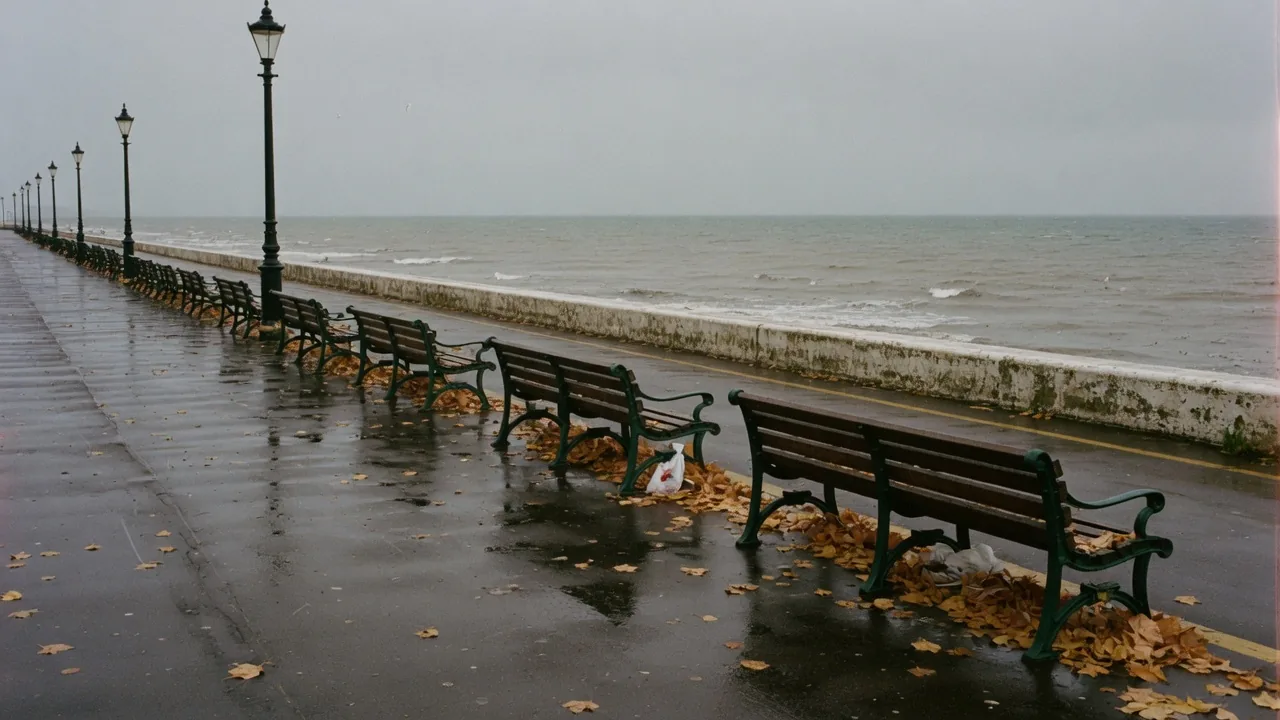
Winter is when the Old Harbour earns the rest of the year. The kiosks shut. What remains is the working quay: boats still landing, the Town Bridge still lifting on the winter timetable, pubs on both sides that never needed a school holiday. Sitting in a harbour pub while rain hits the water is a perfectly good use of two hours. The rain guide applies in January as much as in July.
The Esplanade in a blow, sea running and terraces lit, is why the shelters were put there. Best walking on the level ground; worst for daylight and hours. Portland Castle and several paid sights reduce hours from November to March; SEA LIFE and The Tank Museum at Bovington run year-round.
New Year’s Eve is the winter carnival: fancy dress in very large numbers, not a quiet harbour evening. Christmas Day harbour swim is on the council leaflet for 25 December. A midweek in February is neither.
Dogs are back on the main sand from 1 October. From 1 May to 30 September they are restricted to the signed ends — Pavilion dog area, Greenhill groyne to Overcombe, Bowleaze. Check the stencils.
A wet Weymouth day is a harbour day, a Nothe Fort day — casemates and tunnels are the weatherproof half — and a SEA LIFE day at Lodmoor. It is also a train to Dorchester for Dorset Museum & Art Gallery, or a bus and taxi to Bovington for the tanks. The fort’s upper ramparts close in wind and rain; the year-round 1 still crosses to Portland. The family guide covers the rest.
May for a town that still has room and a walk on the Nothe without a queue. June for the evenings, and for the folk festival or Armed Forces Weekend only if that is the trip. September for warm water, light on the front, a table on the quay.
Easter and August on purpose, with a Lodmoor or Nothe afternoon in the plan and a bed already paid for. Monday fireworks as their own evening. Carnival only once you have checked it is actually on.
Weymouth does not close. The front gets full, the weather comes in, or both. The harbour and the east end are why that is survivable. Come by train if August is the week you have; the without a car piece is that arrival. Pick the month that matches the trip you actually want, not the month the rest of the south of England is also free.