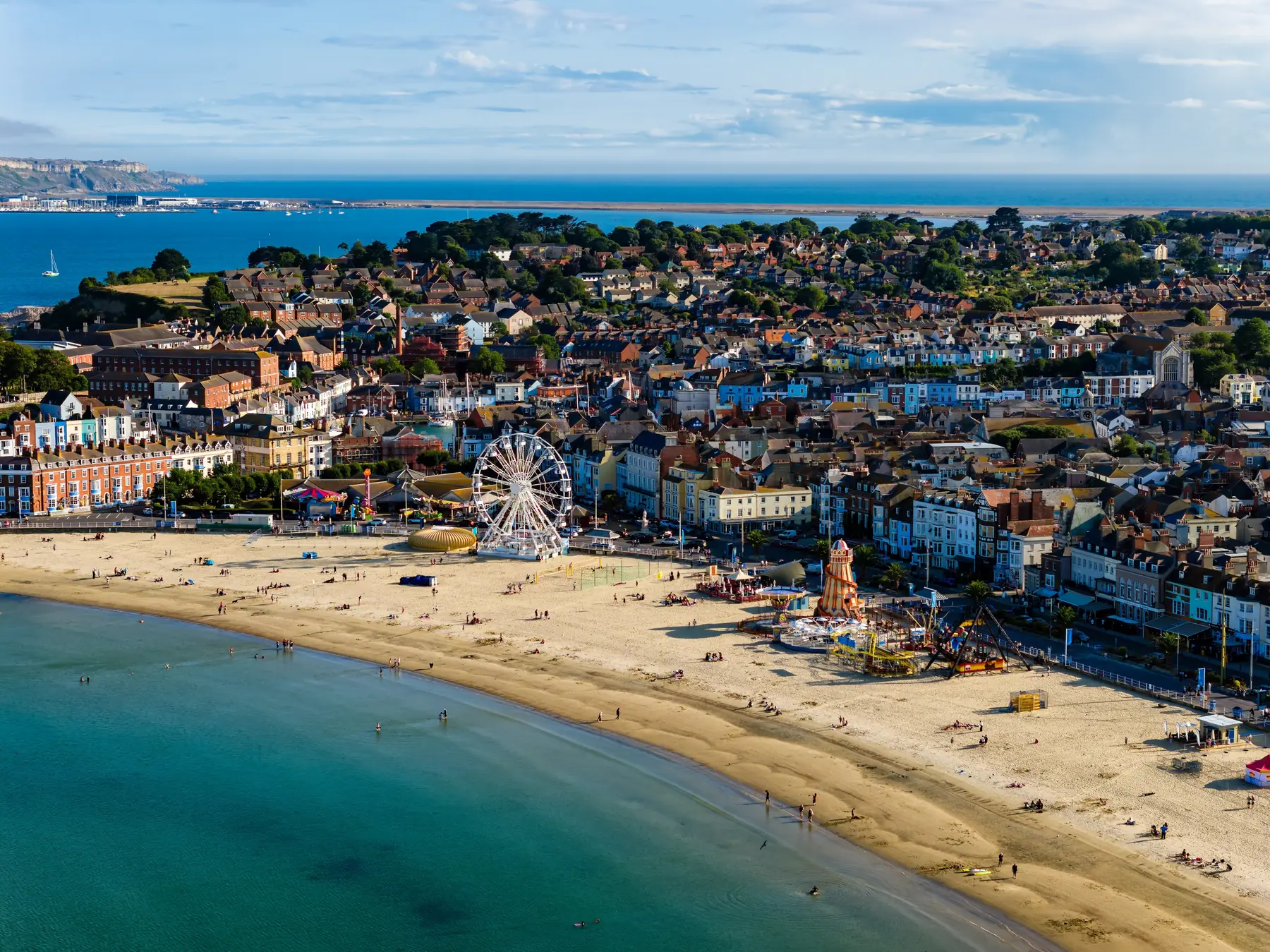
Weymouth has the best town beach on the south coast of England, and the reasons are geological and historical in about equal measure. The bay faces east and is sheltered by the Isle of Portland from the prevailing south-westerlies, so the water is calm. The sand is fine and pale and shelves very gently, so the shallows run a long way out. And the town behind it was built by Georgians who knew exactly what they had.
Weymouth Beach curves for well over a kilometre in front of the Esplanade, from the harbour end to Greenhill. The sand is fine-grained — good enough that professional sculptors have worked it for over a century — and the slope into the water is so gradual that at low tide the shallows extend a very long way.
That combination makes it exceptional for young children and unusually safe for swimming. Lifeguards patrol the main section in season.
It is also, still, a fully traditional beach. Punch and Judy has been performed here since the nineteenth century and continues in summer. Donkey rides run along the sand. There are deckchairs, pedalos, trampolines, a helter-skelter and, at the harbour end, the amusements.
Weymouth’s sand is the reason for a genuine local tradition. Sculptors have worked this beach commercially since the 1920s, and the craft has been handed down in the town. In season there are large sculptures on the sand, and Sandworld at Lodmoor is a permanent park of them under cover.
Behind the beach runs a curve of Georgian and Regency terraces, painted in pastel colours, which is one of the best-preserved seafronts of its period in Britain.
Weymouth owes it to George III. He first came here in 1789 to try sea bathing on medical advice, returned repeatedly for the next fourteen years, and made the town fashionable overnight — the whole of the Esplanade behind you was built to house the people who followed him. His statue, painted and gilded, stands at the northern end; his bathing machine is commemorated too.
The Jubilee Clock, an ornate cast-iron clock tower of 1887, is the seafront’s other landmark and the standard meeting point.
Three of them along the front, all free.
Alexandra Gardens at the harbour end are the oldest, laid out in the nineteenth century. A concert hall was built here in 1924 and later became an amusement arcade; today the gardens are green space with an events space and the amusements alongside.
Greenhill Gardens at the northern end climb from the promenade with formal planting, tennis courts and bowling greens, and a view back over the whole bay.
Nothe Gardens, round the harbour on the headland, are wooded and quiet with the best views in the town.
Round the southern end of the beach is the Old Harbour, and it is a different Weymouth: a working quay with a seventeenth-century waterfront, fishing boats landing crab and scallops, yachts, and a lifting bridge that stops the traffic several times a day to a published timetable — free entertainment, and reliably drawing a small crowd.
The quays on both sides are lined with pubs and restaurants, and crabbing off the wall is a Weymouth institution.
Bowleaze Cove, three kilometres east, is quieter with a funfair behind it and the Osmington White Horse on the hill above.
Lodmoor at the eastern end of the seafront holds SEA LIFE, Sandworld, adventure golf and the RSPB reserve.
Sandsfoot and the beaches towards Portland are pebbly and much quieter.
Chesil Beach, beginning at Ferrybridge, is eighteen miles of shingle and a completely different proposition — dramatic, but with a steep shelf and a dangerous undertow. Do not swim off it.
Parking. The Esplanade and harbour car parks fill early in summer; there is a park and ride on the edge of town.
Getting there. Weymouth station is a few minutes’ walk from the beach, at the end of the line from London Waterloo and of the Heart of Wessex line from Bristol.
Tides. The beach is large at every state of the tide, which is unusual on this coast and part of what makes it reliable.
Dogs face seasonal restrictions on the main beach section through the summer; the ends are more relaxed. Check the signs.
Season. Lifeguards, donkeys, Punch and Judy and the beach concessions run through the summer. The Esplanade in winter, with the sea running and the terraces lit, is a good deal better than most seafronts out of season.
Two pieces of geography make Weymouth Bay what it is. Portland sits four miles to the south like a breakwater, blocking the prevailing south-westerly swell, and the bay itself faces east — which means the water is calm, the beach does not get pounded, and the fine sand stays put rather than being scoured away.
That is also why the town became a resort rather than a fishing village that stayed one. It has a harbour that works, a beach that is safe to swim from, and a sheltered anchorage — which is why the Royal Navy took Portland Harbour, why the 2012 Olympic sailing was held here, and why George III could be persuaded to bathe.
Summer brings the full traditional apparatus — donkeys, Punch and Judy, the sand sculptors, deckchairs and the beach concessions — plus the carnival in August with its air display over the bay.
Out of season the Esplanade is arguably better: the Georgian terraces lit along the curve of the bay, the sea running, and the whole thing to yourself. Weymouth has enough resident population that the seafront pubs and restaurants stay open, which is not true of smaller resorts.
Worth looking up as you walk. The seafront’s terraces are largely late Georgian and Regency, built in a rush between the 1780s and the 1830s to house the visitors who followed George III, and they survive to an unusual degree — much of the curve is unbroken.
Look for the Royal Hotel at the harbour end, the Gloucester Hotel where the King stayed, the painted King George III statue of 1809, and the Jubilee Clock of 1887, which marks the point where the Georgian resort ends and the Victorian one begins.
Behind the seafront, St Mary Street and St Thomas Street are the older town, and the Old Harbour’s seventeenth-century waterfront is older still.
Yes — fine, pale sand along its full length, and it shelves very gently into a sheltered bay.
Among the best in Britain. The water is shallow a long way out, the bay is sheltered and there are lifeguards in season.
Yes, both, in season. Punch and Judy has been performed on this beach since the nineteenth century.
Because George III came here to bathe from 1789 and made the town fashionable, and the Esplanade was built to house the visitors who followed.
No. It has a steep shingle shelf and a dangerous undertow. Swim in Weymouth Bay instead.