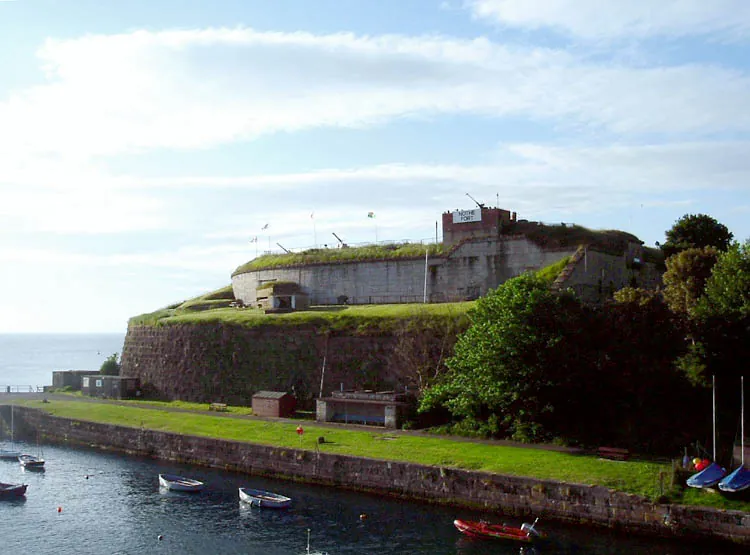
Nothe Fort stands at the end of the Nothe peninsula, the headland that juts east between Weymouth Harbour and Portland Harbour, ten minutes’ walk from the town.
It was built between 1860 and 1872 as part of the Palmerston programme of coastal defences — the fortifications thrown up when Britain became convinced that Napoleon III’s France was about to invade, which it did not. They are collectively and unkindly known as Palmerston’s Follies.
Nothe was built to defend the newly created Portland Harbour, then being enclosed by enormous breakwaters as a Royal Navy anchorage.
Three levels: a magazine and tunnels below, a casemated gun level in the middle with the embrasures facing out to sea, and an open ramparts level on top.
Seventy rooms in total, most of them open, connected by tunnels and stairs — which makes it a considerably bigger site than the exterior suggests.
Guns in the casemates, including large Victorian rifled muzzle-loaders, and later gun positions on top from the fort’s twentieth-century service.
It was garrisoned through both world wars — anti-aircraft guns in the Second — and Weymouth was heavily bombed. It was decommissioned in 1956 and was derelict by the 1970s.
Nothe was rescued by volunteers and is run by a charitable trust, and the transformation over the last decade is the thing returning visitors comment on most.
Displays now cover the fort’s construction, the Victorian navy, both world wars, the D-Day embarkation from Weymouth, and the fort’s own restoration. There are hands-on exhibits, tableaux, a tunnel section with lighting and sound, and things for children throughout.
The staff and volunteers attract consistent praise, and the café food is specifically well rated.
The fort also hosts temporary exhibitions — recent ones have included The Longest Yarn, the enormous knitted D-Day tableau, which drew visitors from a long way.
The ramparts are the other half of the ticket: a 360-degree view over Weymouth Bay, the harbour, Portland Harbour and its breakwaters, the Isle of Portland and the whole sweep of the Dorset coast.
Nothe Gardens, beside the fort, are free — a wooded park on the headland slope with paths down to the harbour and the sea, and they are lovely in their own right.
One recurring comment is that the surrounding area — the gardens and the approach — could be better maintained in places, and that the setting deserves more investment than it gets. That is a fair observation about a site run on volunteer effort and a charity’s budget, and it does not detract from the fort itself.
Admission charged; the ticket is normally valid for repeat visits over a period — ask, because it substantially improves the value.
Time: two to three hours.
Facilities: café — well rated — shop, toilets.
Access: the site has multiple levels connected by stairs and slopes; parts are accessible, others are not. Check in advance.
Season: open through the main season with reduced winter opening; check before travelling.
Events: re-enactments, night tours and family events through the year.
Getting there: Barrack Road, on the Nothe peninsula — ten to fifteen minutes’ walk from the harbour, up a hill, or use the rowing ferry across the harbour to shorten it.
Built between 1860 and 1872 as part of the Palmerston coastal defences, to protect the new Portland Harbour.
Seventy rooms across three levels, plus tunnels and a ramparts walk — bigger than it looks from outside.
Usually yes, for repeat visits over a period. Ask when you buy.
Yes — Nothe Gardens beside the fort are free and open.
Two to three hours.