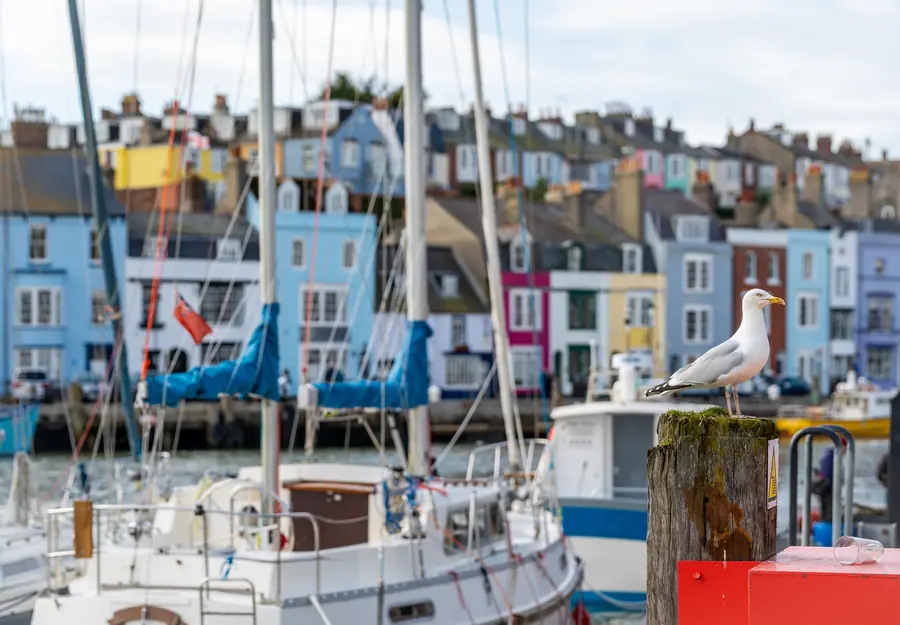
Weymouth is one of the few south-coast resorts where leaving the car at home is a plan rather than a dare. The station is in the town. The promenade is level for the length of the bay. The harbour is a walk. Portland needs a bus. The Tank Museum is at Bovington, which is not a walk. That last fact is the one that catches people who packed as if Dorset were compact.
This is the car-free stay. The parking article is the other one.
Arrive at Weymouth station. Walk to the beach, the Esplanade and the harbour. Use the promenade as your main road as far as SEA LIFE Weymouth and Lodmoor. Climb the Nothe for the fort. Take First Bus 1 for Portland, and the seasonal open-top 11 if you want the Bill. Do not try to do the Tank Museum, Portland Bill and Durdle Door on the same day without looking at a timetable first. Frequencies change; check the day’s First Bus 1 and the seasonal 11, not a paragraph in a guide.
Weymouth station sits on King Street, a few minutes’ walk from the beach and the shops, a little longer to the harbour. That single fact is the argument for not bringing a car.
South Western Railway runs to London Waterloo via Poole, Bournemouth and Southampton — around three hours to London on a good service. The Heart of Wessex line runs north through Dorchester West to Yeovil, Castle Cary and Bristol. Dorchester South is the other county-town station, on the Waterloo line, ten minutes. Pattern and Sunday service move; National Rail is the document to trust. Upwey, one stop north, is not a useful substitute for the town. Our getting here page has the Waterloo and Heart of Wessex arrivals into King Street.
The station is a terminus. Out of the front, the town is in front of you. King’s Statue on the Esplanade is the bus hub for everything that is not a walk. You do not need a taxi for the sand, the quay or St Mary Street. There is an APCOA station car park, priced for people catching trains. You do not need it.
The Esplanade is level, surfaced, and it runs the full arc of Weymouth Beach from the harbour end to Greenhill and on toward Lodmoor. Alexandra Gardens sit at the Pavilion end; Greenhill Gardens climb from the promenade about a kilometre and a half north-east; SEA LIFE is at the far end, twenty to twenty-five minutes along the front, no hill.
The Old Harbour is the other walk, and it is not the beach. Custom House Quay, the Town Bridge, Trinity Road, Hope Square: twenty minutes to circuit both banks if you do not stop, an hour if you do. The rowing ferry crosses in season and saves the bridge.
What walking does not do: Portland Bill, the Tank Museum, Abbotsbury, Lulworth. Those are bus, train, or a car. The day trips page is the rest of that map. Buggies are fine on the promenade and the quays. They are not fine on the Nothe as a casual extra. Plan the hill, or skip it. Crabbing off the harbour wall is free entertainment once you have a line.
Nothe Fort stands at the end of the peninsula that juts between Weymouth Harbour and Portland Harbour. From the quay it is ten to fifteen minutes up. From the station it is longer. The gardens beside the fort are free and wooded; the fort is ticketed, three levels, tunnels, a ramparts view.
This is the one walk in the town centre that is a climb. It is real with a buggy or tired children at the end of a beach day. The rowing ferry lands you on the right bank and shortens it. Treat the Nothe as its own outing, not as an add-on between Punch and Judy and lunch. In wind and rain the upper ramparts close; the casemates do not. See Weymouth in the rain.
The car-free way to the island is the bus, not a causeway you then have to park on.
First Bus 1 is the year-round service from King’s Statue to Portland — Wyke Regis, Fortuneswell, Easton — frequent through the day. That is how you reach Portland Castle at Castletown without a car. Check the day’s timetable; Ferrybridge roadworks have been known to slow it. The causeway is not a comfortable walk with a day’s kit.
Service 11 is the seasonal open-top to Portland Bill, advertised for 2026 as daily from late May to mid-September. It is the old Coaster idea under a current number; older pages still say 501. Trust First Bus, not a screenshot. The Bill, the lighthouse and Pulpit Rock are the reason to take it. The Portland article is that day; this page is only the bus.
Service 4 runs toward Preston and Overcombe, useful for Lodmoor if you do not want the promenade. X53 runs west toward Abbotsbury, Bridport and Lyme Regis. X54 (with summer X50 open-top) runs east toward Lulworth, Wool and Swanage. They thin out on Sundays and in winter. Check First Bus the night before. Contactless is normal; a day ticket is often cheaper than hopping.
The Rodwell Trail is the flat walk toward Ferrybridge and Sandsfoot Castle, a former railway, no bus required. Portland beyond the causeway is still a bus.
The Tank Museum is at Bovington Camp, eighteen kilometres north-east, a full indoor day. It is not in Weymouth. It is not on the 1.
Train to Wool, on the Waterloo line, then a taxi — or a walk that is not a casual pushchair stroll. Service 55, seasonal, late May to mid-September, is the bus that actually serves Bovington. X54 gets you to Wool on a fuller summer timetable and a thinner winter one. Look up the combination the night before. Do not discover the last return at the gate.
Monkey World is next door and the same problem. If the tanks are the wet-day plan, they are a good plan. They are not a car-free afterthought between the beach and tea.
Ten minutes to Dorchester South or Dorchester West. Both stations are a short walk — under twelve minutes, not step-free — from Dorset Museum & Art Gallery on High West Street. The museum is the county’s archaeology, geology and Hardy, a reconstructed study, a proper wet day. Other indoor sights sit in the same small town. Maiden Castle, the Iron Age hillfort, is on the edge: free, open, a walk or a local bus.
Check the museum’s visit page for train offers rather than a fare copied here. Hardy’s Cottage and Max Gate are nearby, with the usual National Trust caveats about a cottage in a lane without a car.
A wet Weymouth day is a harbour day, a Nothe tunnels day, a SEA LIFE day, and a train to Dorchester. It is not a day you need a vehicle for, unless the tanks are the point. SEA LIFE at Lodmoor is mostly indoors; walk the promenade or take the 4. The family guide is the list.
The harbour pubs do the rest. The gulls will still be on the posts. That quay, those birds, that town.
Park once at home. Day one: station, Esplanade, beach, harbour, Nothe if the legs agree. Day two: bus 1 and 11 to Portland and the Bill. Day three: promenade to Greenhill, SEA LIFE, Lodmoor. Day four: train to Dorchester and the museum. A wet day that never leaves the quay. A family day at Bovington only after you have checked Wool.
What the car is actually for: the Tank Museum with tired children and a timetable that does not exist. Abbotsbury after the last X53. Tyneham when the range is open and the bus is not.
What it is not for: the beach, the harbour, Alexandra Gardens, Greenhill, the Nothe, SEA LIFE, Sandsfoot on the trail, a first look at Portland Castle from Castletown. For those, the car is something you then have to park. The when to visit page is the calendar. This page is the way in.