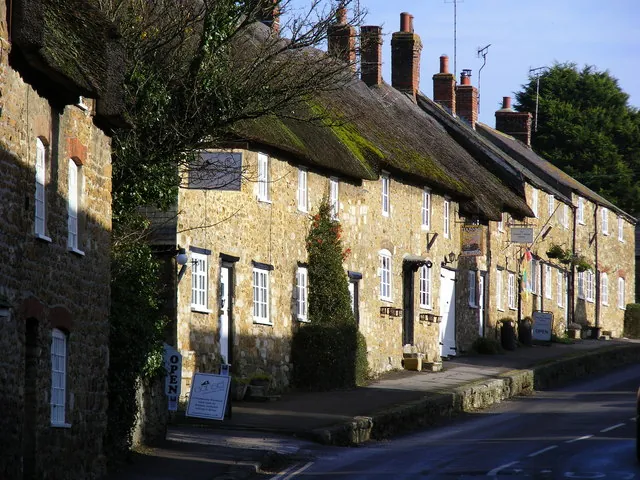
Abbotsbury is a village and civil parish of 451 people at the 2021 census, on the Dorset coast west of Weymouth and a mile (1.6 km) inland from the English Channel at Chesil Beach. Almost everything visitors come for is an inheritance from a Benedictine abbey destroyed nearly five centuries ago: a swannery more than 600 years old, the world’s largest thatched tithe barn, and a 14th-century pilgrimage chapel on a bare hill between the village and the sea. Much of it, the swannery and the gardens included, still belongs to the Ilchester Estate, which holds 61 square kilometres (15,000 acres) of Dorset.
The straight-line distance from Weymouth is 12.1 km; Wikipedia, measuring directly rather than by road, puts it about 7 miles (11 km) northwest. The B3157 is the road between them and the main street through. Wikipedia calls Abbotsbury a tourism honeypot and a gateway to the Jurassic Coast World Heritage Site: the parish coastline forms part of that site, and the South West Coast Path and Macmillan Way both run through the village.
The swannery lies south of the village on the shore of the Fleet, the brackish lagoon that Chesil Beach — an 18-mile (29 km) barrier beach — encloses below Abbotsbury. It is over 600 years old: the abbey’s monks kept it for meat, working the birds with decoys, and it passed to the earls of Ilchester when the abbey fell. A large colony of mute swans breeds here alongside other waterfowl, and cygnets can be seen at close quarters from May through the summer. It carries 4.7 from 1,807 Google reviews.
Reviewers write about feeding times, staff talks and a full-size maze. A visitor in June 2026 wrote, “You will leave educated and fulfilled - it’s very calm and peaceful.” Access comes up repeatedly: a visitor in July 2026 noted a “big car park with a short walk to the site” and that “The paths are wheelchair friendly”.
The Subtropical Gardens are the busiest thing here by review count, at 4.7 from 3,893 Google reviews. The Countess of Ilchester founded them in 1765 as a kitchen garden for the nearby castle; they now cover 20 acres of exotic plants, many of them newly discovered species when introduced. Storms in 1990 destroyed many rare specimens, since replaced by younger plants.
Complaints are thin on the ground. A visitor in July 2026 recorded two ways round the site, “disabled labeled way and harder”. The one dissenting note, a four-star review from July 2026, found the closing routine heavy-handed: “just before closing there is a large siren to alert you that the site is closing, this felt a little oppressive”.
St Catherine’s Chapel stands south of the village on a bare hill about 80 metres (260 ft) high. Small, 14th-century and built entirely of stone down to the roof, it served the abbey’s monks as a place of private prayer and, overlooking the Channel, may also have worked as a beacon warning sailors of the nearby Isle of Portland. It is listed Grade I and carries 4.7 from 240 Google reviews.
A visitor in August 2026 wrote, “Brilliant place, only a short walk from town”. A visitor in November 2025 was clear about what is not there: “The inside is plain and not renovated or maintained so nothing inside worth really seeing.” Go for the hill and the position rather than the interior.
Inland, the earthworks of Abbotsbury Castle, an Iron Age hillfort at the top of Wears Hill a mile and a half (2.4 km) northwest, draw far less traffic, at 4.5 from 69 Google reviews.
A 10th-century charter of King Edmund records land at Abbedesburi, a name suggesting it once belonged to an abbot. In the 11th century Cnut granted land at nearby Portesham to a Scandinavian thegn, Orc, who settled here with his wife Tola and founded the abbey; Orc also gave the village a guildhall, recorded in the oldest surviving guild charter in England.
The abbey lasted 500 years before the dissolution destroyed it. Its stone went into the village, including the house of its new owner, Sir Giles Strangways, which was itself besieged and burned in 1644 when Parliamentarians fought Royalists here; the gunpowder store exploded and took the old abbey records with it. Two bullet holes from that fight remain in the Jacobean pulpit of St Nicholas, the Grade I parish church. Little of the abbey stands above ground now: the Abbey Remains carry 4.2 from 48 Google reviews, the lowest rating of the village’s sites.
The barn survived. Built around 1400 and measuring 83 by 9.5 metres, it is the world’s largest thatched tithe barn, 23 bays of which 11 have stood unroofed since the 17th century. Fires in the late 17th and early 18th centuries destroyed virtually all the medieval village, which is why the long street of stone houses, many of them thatched, is largely 17th- and 18th-century work, broadening at one point into an old market square. Fishing was once the main industry here, and the population approached 1,100 by the 1860s against 451 today.
The B3157, known locally as the coast road, runs from Weymouth through the village towards Bridport, and the stretch west to Burton Bradstock is promoted as a scenic route for its coastal views. Cyclists know it for Abbotsbury Hill just west of the village, a 200-metre (660 ft) climb with gradients of up to 20 per cent.
Without a car, the bus is the route. First Hampshire & Dorset’s Jurassic Coaster X53 serves the village, with the X52 running in summer only, linking Axminster, Lyme Regis, Bridport, Weymouth, Lulworth Cove and Wool. In Weymouth the coastal buses go from the King’s Statue stops, a short walk from the railway station, and Plusbus add-ons cover them.
There is no station. The Abbotsbury Railway, a 6 miles (10 km) branch off the main line to Weymouth, ran from 1885 to 1952, built mainly for freight in the expectation of oil shale, stone and iron ore; its terminus ended up east of the village because the company could not buy land nearer the centre. Wikipedia gives Abbotsbury as 6 miles (10 km) from Upwey railway station, the second station on the Weymouth line. On foot, the coast path runs straight through the village, so walking in along the shore is a genuine option.
The village and what is around it, at walking scale.
Open any of them in Google Maps for directions and current opening.
Attractions, prices and availability in Weymouth
These come from GetYourGuide's booking widget, which sets their cookies in your browser. Consent to load it and see the attractions and prices.
Background on Abbotsbury draws on its Wikipedia article, text there being available under CC BY-SA 4.0.