Weymouth Beach is a gently curving arc of sand in Weymouth Bay, running the length of the town in front of The Esplanade.
It is very wide, very gently sloping, made of golden sand with shallow water and small waves, and it is one of the safest and most straightforward family beaches in England.
George III came here for his health in 1789, and returned repeatedly over fourteen years.
He bathed from a bathing machine, reportedly to the accompaniment of a band playing God Save the King concealed in a neighbouring machine, and in doing so made sea-bathing fashionable for the whole country. Weymouth was transformed from a port into a resort, and the Georgian Esplanade — a long, unbroken, colour-washed terrace facing the sea — was built to accommodate the people who followed him.
There is a statue of George III at the end of the Esplanade and a white horse cut into the chalk at Osmington with the king on it, riding away from the town, about which the locals have a story.
The Esplanade survives essentially intact, and it is the reason Weymouth’s seafront looks the way it does — a single sweeping composition rather than a jumble.
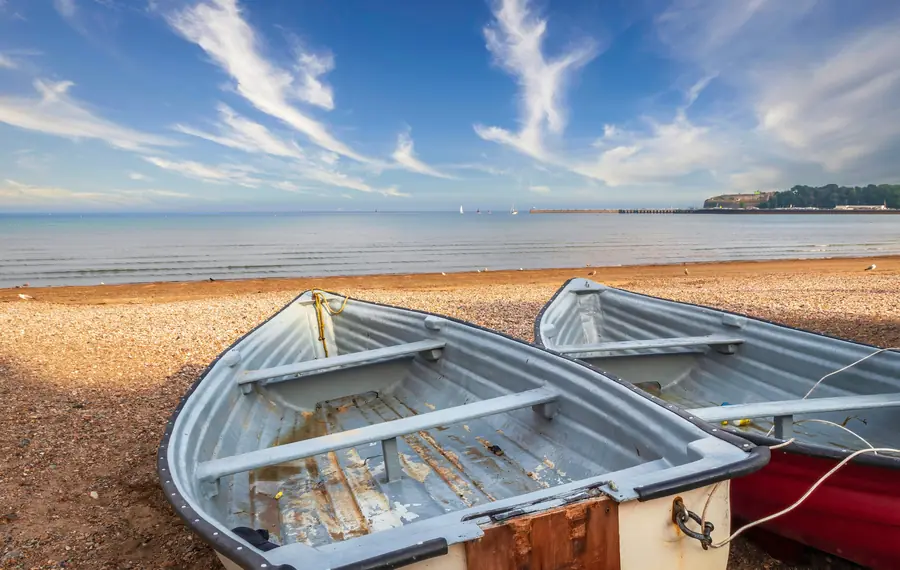
Shingle at the top, which is where people sit — you can put a towel down without getting sand in everything — falling to soft yellow sand at the water’s edge as the tide goes out.
Very shallow and gently shelving, so the water is warm and safe and children can go a long way out without being out of their depth. It is genuinely one of the best beaches in Britain for small children.
Lifeguards in season.
Swimmers and paddleboarders use the bay year round.
Weymouth keeps things that have vanished elsewhere.
Punch and Judy — performed here since the 1880s, one of the last permanent seaside Punch and Judy shows in Britain.
Donkey rides.
Sand sculpture — Weymouth has a tradition of it going back over a century.
Deckchairs, pedaloes, trampolines and the full apparatus.
Kiosks and cafés along the Esplanade, and the town’s shops immediately behind.
Free, open at all times.
Parking: the Esplanade and town car parks, busy in summer. Parking at the SEA LIFE centre at Lodmoor and walking across is a common and effective tactic.
Facilities: toilets, cafés and kiosks the length of the front.
Access: the Esplanade is level throughout, with ramps and beach access points; beach wheelchairs are available in season.
Getting there: Weymouth station is five minutes from the beach, with direct trains from London Waterloo and Bristol.
The Harbour — the seventeenth-century waterfront, five minutes south.
Nothe Fort on the headland beyond the harbour.
Greenhill Gardens at the northern end of the Esplanade.
SEA LIFE Weymouth at Lodmoor.
Portland, Chesil Beach and the Jurassic Coast start a few kilometres south.
Shingle at the top where people sit, and soft golden sand from mid-beach to the water.
Exceptionally — it is very wide, very gently shelving, and the water stays shallow a long way out. Lifeguards patrol in season.
George III came here for sea-bathing in 1789 and returned for fourteen years, making the practice fashionable and the town a resort.
Yes — Weymouth has one of the last permanent seaside Punch and Judy shows in Britain, running since the 1880s.
The Esplanade and town car parks, or at the SEA LIFE centre at Lodmoor and walk across.