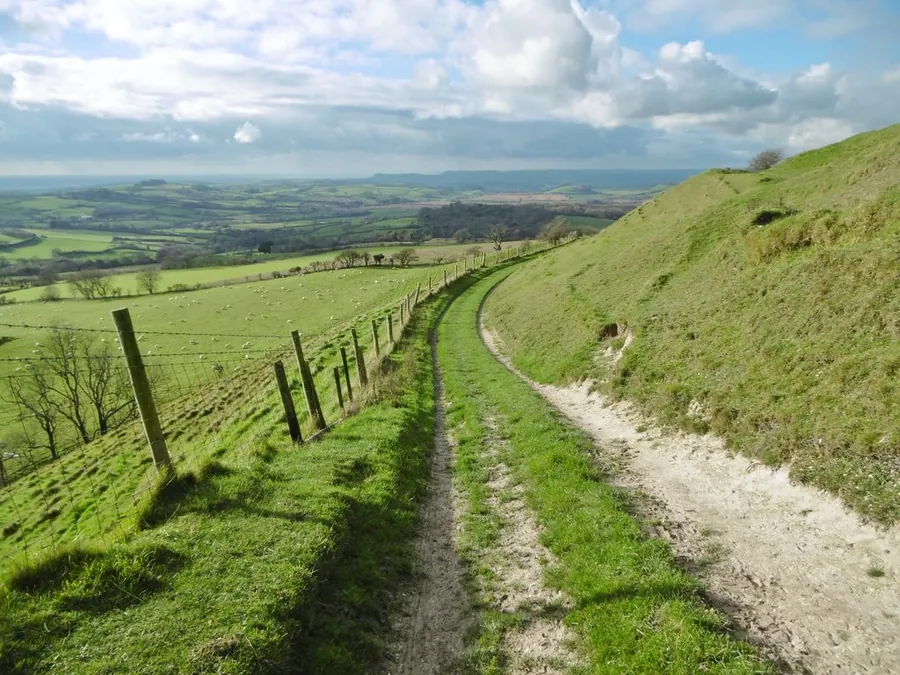
The Dorset National Landscape — still legally designated the Dorset Area of Outstanding Natural Beauty — covers about 1,129 square kilometres, roughly 40 per cent of the county.
It was established in 1959, in the first wave of such designations, and it is one of the largest in England.
Weymouth sits in the middle of it.
The chalk downland of central Dorset — rolling, sheep-grazed, cut by dry valleys, and carrying an extraordinary density of prehistoric monuments.
The Jurassic Coast — the 155-kilometre UNESCO World Heritage Site running from Exmouth to Studland, where the cliffs expose 185 million years of Earth history in sequence, from Triassic through Jurassic to Cretaceous, laid out west to east like a book.
Chesil Beach — an 29-kilometre shingle barrier running from Portland to West Bay, with the Fleet lagoon behind it. The pebbles are graded by size along its length, from pea gravel at the western end to cobbles at Portland, so precisely that fishermen landing at night could reportedly tell where they were by feel.
The Isle of Portland, tied to the mainland by Chesil, source of the stone for St Paul’s Cathedral, the Cenotaph and the United Nations building.
The Purbeck Hills, the heaths, and the river valleys of the Frome and the Piddle.
Durdle Door and Lulworth Cove, twenty minutes east — the limestone arch and the almost-circular cove, the two most photographed things in Dorset.
Maiden Castle, eleven kilometres north near Dorchester — the largest Iron Age hill fort in Britain, with ramparts enclosing 47 acres. Free, open, and genuinely staggering at ground level.
The Cerne Abbas Giant, a 55-metre chalk figure of disputed age cut into a hillside north of Dorchester. Its dating has been argued over for centuries; recent scientific work suggests late Saxon origins rather than prehistoric or seventeenth-century. Visitors sometimes report their tour guides being more interested in the figure’s anatomy than its archaeology, which is a fair summary of most commentary on it.
Corfe Castle, forty minutes east — a slighted Norman castle on a gap in the Purbeck ridge, National Trust.
Golden Cap, the highest point on the south coast of England at 191 metres, west along the coast.
Lyme Regis and Charmouth, for fossils — the cliffs here yield ammonites and marine reptiles, and this is where Mary Anning made the discoveries that helped establish palaeontology.
The South West Coast Path runs the whole length of the coast.
The Jurassic Coast is best walked in sections, and the X53 Jurassic Coaster bus runs along it, making one-way walks straightforward.
Inland, a dense network of footpaths crosses the chalk, and the Wessex Ridgeway and Hardy Way cross the county.
Free. It is a lived-in working landscape, not a park — farms, villages and towns, with public rights of way throughout. There is no gate and no admission.
Parking at the honeypots — Durdle Door, Lulworth, Corfe — is charged and fills by mid-morning in season.
Busy: the famous places are very busy in summer. The rest of it is not, at all, which is the best thing about it.
About 1,129 square kilometres, roughly 40 per cent of Dorset, designated in 1959.
A 155-kilometre UNESCO World Heritage Site where the cliffs expose 185 million years of Earth history in sequence from west to east.
A 29-kilometre shingle barrier from Portland to West Bay, with pebbles graded by size along its length and the Fleet lagoon behind it.
Durdle Door and Lulworth Cove twenty minutes east, and Maiden Castle — the largest Iron Age hill fort in Britain — eleven kilometres north.
Yes. It is working countryside with public rights of way; only parking and individual attractions charge.