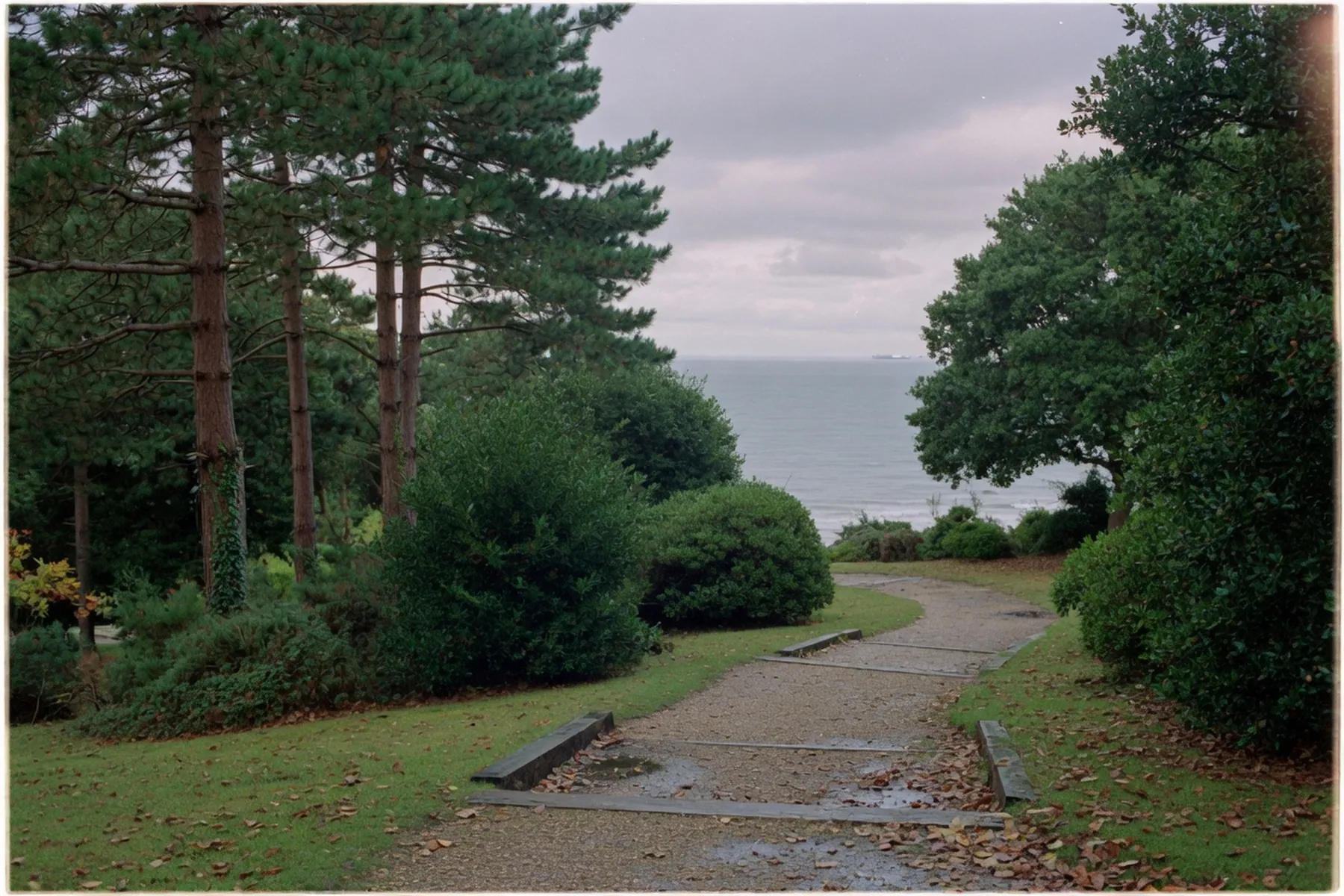
Nothe Fort sits at the seaward end of the Nothe peninsula, the wooded headland that divides Weymouth Harbour from Portland Harbour. You come for a Victorian gun fort that still reads as a working machine: Portland-stone walls, casemates around a parade ground, magazines underneath, later guns on the grassed ramparts. The gardens around it are a different visit, and they are free.
Weymouth Civic Society run it. Historic England lists the fort and outer gateway at Grade II*, and schedules the fort, the Fusee Steps tramway and a searchlight battery as a monument. None of that is English Heritage. Membership of one does not open the other.
The job was Portland Harbour, not the town beach. From 1847 the Admiralty built the breakwaters that turned Portland Roads into a naval anchorage. The Verne and East Weare on the island, the breakwater forts, and the Nothe on the mainland were the ring meant to keep a French fleet out of it.
The 1859 Royal Commission on the defence of the United Kingdom produced the coastal works later nicknamed Palmerston’s follies. Historic England puts Nothe in that group and calls it one of the better-preserved examples of the 1860s. The Civic Society’s timeline is more specific: building started in 1859, the structure was complete by 1869 and left unarmed, and in 1872 twelve muzzle-loading coastal guns went into the casemates.
By 1890, Historic England notes, newer guns and the rest of the Portland ring had overtaken it. It became infantry barracks, then a part-time battery. A visitor today walks a Victorian plan with twentieth-century additions on top.
The listed building is a demi-lune: a straight landward wall to the west, a semi-circular seaward face looking into Portland Harbour. Historic England counts twenty-two casemates at courtyard level, with twelve original gunports, over a continuous circuit of magazines and stores. A caponier on the south-west corner covers the ditch. The outer gateway and its tunnel sit about thirty metres west of the main door.
Start on the parade ground. The casemates are the brick-vaulted gun rooms. Below them the magazines are the weatherproof half of the ticket: tunnels, stores, more volume than the exterior suggests. The ramparts are the other half — later 6-inch emplacements, a Second World War observation post, and the view. Weymouth Bay one way, the island and the breakwaters the other, the Old Harbour under the hill.
The ground is uneven. The operator’s family page is blunt about comfortable shoes.
The original muzzle-loaders did not last. In 1892 seven were swapped for larger 12.5-inch pieces; in 1903 the lot came out for two 6-inch breech-loaders on the ramparts, with a third in 1908. In the First World War they were taken out of service in 1916. In the Second, two of the three came back.
The Civic Society’s wartime page is the document for 1939–45: an anti-aircraft gun by the gatehouse, four more heavy AA pieces in what is now the car park, and the magazines turned into an ammunition store for the south-west. Weymouth and Portland were embarkation ports for American forces bound for Omaha Beach. A D-Day display, put up in 2024 with material from Weymouth Museum, is the current telling of that week. Displays move; check the operator’s exhibitions list.
After the guns were scrapped in 1956 the army used the place for storage, then left. In the 1980s part of the underground level was fitted out as a local-authority emergency control centre. It was decommissioned in 1990. Those rooms are not on the casual circuit. Cold War tours and talks are listed on the what’s-on page.
Weymouth and Portland Council took ownership in 1970. Through the 1960s and 70s the empty magazines were an unofficial playground. The Civic Society’s Amnesty Project, opened in 2025, tells that story on purpose: portraits and a film of the people who used to break in.
Volunteers began the restoration that let a museum of coastal defence open in 1980. It is still a charity, still volunteer-heavy, still the sort of place where a person at a desk will tell you which way to start.
Nothe Gardens are Weymouth Town Council’s, not the fort’s ticket. Informal planting, trees, paths down the slope, picnic grass, and the South West Coast Path running through. Dogs are welcome on a lead. Cycling is not. Public toilets in the middle of the gardens are listed as open all year. The council says the gardens are mainly accessible by wheelchair, with limited access to some of the lower paths, and that some paths are steep or uneven. They sit on the free list for a reason.
Newton’s Cove, at the foot of the slope, is a separate walk: a made path along a defended shoreline, useful if you want the water without a ticket. The gardens café at the entrance is not the Fort View Café inside the casemates. Do not treat them as one kettle.
The Fusee Steps — the 1860s Portland-stone tramway that hauled trolleys up from the quay — sit in the scheduled monument and in the gardens. They are the old supply line, not a ride.
For 2026 the operator’s visit page is the only hours list to use. Daily, 10.00am to 4.00pm, 28 March to 1 November. The Fort View Café runs 10.30am to 3.30pm on those dates. From 2 November 2026 to 13 February 2027 the fort is closed for maintenance. That is not reduced winter opening. Several pages still in search results, including the town council’s gardens page, still publish older hours. They are wrong.
Admission is charged. Every ticket currently includes a free annual pass, which is the detail that changes the value if you are here for more than one holiday. Prices sit on nothefort.org.uk/visit; they move. Book ahead if you want to skip the desk, or pay on the day.
Events sit on the operator’s what’s-on list, and they change. As of early September 2026 that list includes a Family Science Festival on Sunday 13 September, a repeating WW2 Garrison from 19 September to 18 October, artillery displays, a Pirate Weekend on 3–4 October, a Cold War preview exhibition in October, and Halloween half-term from 24 October to 1 November. Check the organiser’s events page before you build a day around any of those dates.
The town has its own calendar in the same weeks: Water Fest on the beach on Saturday 12 September, run by Weymouth Town Council, and Ironman 70.3 on Sunday 20 September. Those fill the parks. The when to visit page is the rest of the year.
From Custom House Quay the fort is about 600 metres as the crow flies, and it is a hill. Follow the south bank of the harbour seaward, then up Barrack Road or the garden paths. The operator times the walk from Weymouth station, along the seafront and the harbour, at twenty minutes. From the quay it is shorter and steeper. Treat it as its own outing, not a bolt-on between the sand and lunch. The walks guide has the peninsula in a longer circuit.
In summer a rowing ferry still crosses from Custom House Quay to a landing at the bottom of the fort. It runs in the summer months and in weather that allows it. If the boat is not there, walk.
The fort’s find-us page names First Bus 1 (Portland) and 10 (Dorchester) and a stop at Boot Hill, then a ten-minute walk through the gardens. First Bus still publishes both routes from King’s Statue; check the day’s timetable on firstbus.co.uk rather than a screenshot. The without a car piece is the wider map.
By car, do not hunt the Esplanade and then try to cross the Town Bridge. Nothe car park is already on Barrack Road. Dorset Council lists 196 spaces, nine disabled, three motorcycle, no height barrier, open twenty-four hours. Charges run 8am to 6pm every day, with a tariff up to ten hours; 6pm to 8am is free. JustPark location 6208. The fort warns that phone signal on the peninsula can be poor — download the app before you leave the quay. Three of the nine Blue Badge bays sit close to the fort. The current tariff is on the council’s Nothe page; the parking guide is the rest of the town.
Allow one to three hours inside, which is the operator’s own band. Fort View Café occupies a casemate and the parade ground, 10.30am to 3.30pm in season.
There is an accessible route into reception, ramps on the parade ground, and a lift at the far end that serves the magazine level and the ramparts. The lift opening is 1150 mm by 850 mm; the operator says some large, high-backed scooters will not fit. Wheelchairs are available on site. A registered carer is admitted free with evidence. None of that makes every tunnel a graded access path. Read the fort’s access page before you go. Quieter hours, from the same page: 10–11am and 2–3pm.
Do not confuse this with Sandsfoot Castle, the free Henrician ruin on the Rodwell Trail, or with Portland Castle, the complete Device fort on the island. Give the Nothe its own afternoon; walk Sandsfoot on the trail another day. When the fort is shut for the winter works, the gardens and the harbour are still there. The rain guide covers the rest of the town indoors.