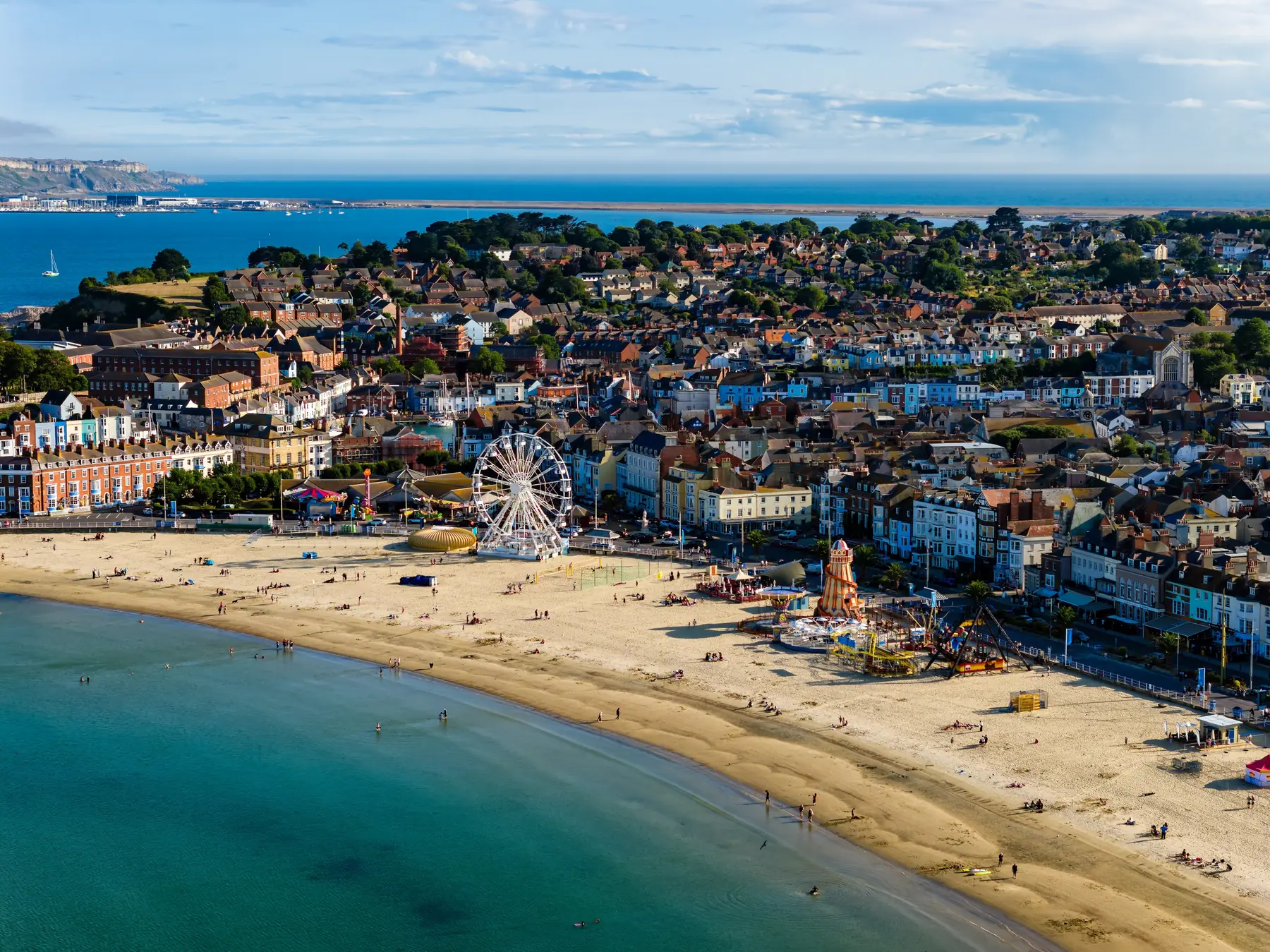
Weymouth is one of the cheaper English resorts to spend a day in, largely because its best asset — a kilometre of fine sand on a sheltered bay — is free, and so is nearly everything around it. The Georgian seafront, the working harbour, three public gardens, a ruined Tudor castle, two nature reserves and the largest Iron Age hillfort in Britain all cost nothing.
Weymouth Beach is a broad arc of fine sand, gently shelving, sheltered and lifeguarded in season. It is free, it is large enough not to feel crowded even in August, and it has the traditional apparatus — Punch and Judy, performed on this beach since the nineteenth century, and donkey rides — going on around you at no charge to watch.
The Esplanade behind it is a curve of Georgian and Regency terraces, the legacy of George III, who came here to bathe from 1789 and made the town fashionable. His statue stands at the northern end, and the Jubilee Clock is the seafront’s other landmark.
Watching the sand sculptors work is free, and the tradition here goes back over a century.
The Old Harbour is the best thing in Weymouth after the beach: a working quay with a seventeenth-century waterfront, fishing boats, yachts and a lifting bridge that stops the traffic several times a day, lined with pubs on both sides.
Crabbing off the quay costs the price of a line and a bit of bait, and it will occupy a child for an hour.
The town bridge lifting is a free spectacle and happens to a published timetable.
Nothe Gardens, on the headland above the harbour, are free, wooded and quiet, with the best views in Weymouth — over the harbour one way and to Portland the other. The fort at the top charges; the gardens do not.
Greenhill Gardens, at the northern end of the Esplanade, climb from the promenade with tennis, bowls and formal planting, overlooking the bay.
Alexandra Gardens, by the harbour end of the seafront, are the town’s oldest public gardens.
Lodmoor Country Park at the eastern end has open space, a play area and the RSPB reserve.
Sandsfoot Castle, on the Rodwell Trail a kilometre and a half south, is one of Henry VIII’s artillery forts of 1539–41 — now a ruin, partly lost to the sea, standing in a small free public garden above the water. Free and open.
Portland Castle, its better-preserved twin, charges — but the walk round Portland Harbour to look at it does not.
A level, surfaced former railway line running three kilometres from the town centre south to Ferrybridge, through cuttings and a tunnel, with Sandsfoot Castle on the way. Free, traffic-free and the easiest walk in the town.
RSPB Radipole Lake is a reedbed reserve with a visitor centre and boardwalks in the middle of Weymouth — one of very few nature reserves with a town-centre bus stop. Bearded tits, marsh harriers, warblers and, in winter, wildfowl. Free access.
RSPB Lodmoor, at the eastern end of the seafront, is the second reserve — wetter, wilder and good for waders.
Between them they give Weymouth a bird list that no other south-coast resort can match, and both are free.
Chesil Beach, beginning at Ferrybridge, is an eighteen-mile shingle barrier with the Fleet lagoon behind it — the largest in Britain and internationally important for wildfowl. Free to walk, though the pebbles are hard going and the sea off it is dangerous.
Portland is free to walk on: the coast path runs right round the island, Portland Bill with its lighthouse and Pulpit Rock is free to visit, and Tout Quarry Sculpture Park — a disused quarry full of carvings cut directly into the rock — is free, odd and one of the best things on the island.
The Osmington White Horse, six kilometres east, is a chalk figure of George III on horseback cut in 1808, free to walk up to and the only mounted king among Britain’s hill figures.
Maiden Castle, twelve kilometres north near Dorchester, is the largest Iron Age hillfort in Britain — vast multiple ramparts enclosing a hilltop, free, open and genuinely astonishing when you walk into it.
Maumbury Rings in Dorchester is a Neolithic henge that the Romans converted into an amphitheatre. Free.
Weymouth’s calendar is busy and much of it is free to watch: the carnival and its air displays, the seafood festival, the Portland and Weymouth sailing events on the water where the 2012 Olympic regatta was held, and the town’s famously large New Year’s Eve fancy dress night, which is a spectacle whether or not you join in.
Parking, and the paid attractions if you want them. There is a park and ride and the seafront car parks fill early in summer.
Better, come by train: Weymouth is the terminus of the line from London Waterloo via Bournemouth and Poole and of the Heart of Wessex line from Bristol and Bath, and the station is a few minutes from the beach. The open-top 501 bus to Portland Bill in season is cheap and one of the best bus rides in England.
Start on the harbour early while the boats are working, then round to the Nothe Gardens for the view. Down onto the beach for the middle of the day — Punch and Judy, the sand sculptors and the donkeys are all free entertainment. In the afternoon take the Rodwell Trail south to Sandsfoot Castle, and continue to Ferrybridge for Chesil Beach and the Fleet. Finish at Radipole Lake on the way back into town.
A Georgian seafront, a working harbour, a Tudor ruin, an eighteen-mile shingle bank and a nature reserve, for nothing.
The first free day covered the town. The second should go to Portland, which is free almost in its entirety. Take the open-top 501 bus or drive across the causeway. Walk out to Portland Bill for the lighthouse, Pulpit Rock and the Race. Come back via Tout Quarry Sculpture Park — a free maze of carvings cut into the rock faces of a disused quarry — and Church Ope Cove with Rufus Castle above it.
Everything on that day except the bus fare and the parking is free, and the landscape is unlike anywhere else in England.
A third day goes west along Chesil and the Fleet to Abbotsbury, where the village, the tithe barn and St Catherine’s Chapel on the hill are free even though the Swannery and gardens are not.
Worth checking. Portland Castle is English Heritage; Hardy’s Cottage, Max Gate, Clouds Hill, Corfe Castle and Studland are National Trust. Nothing on the free list needs either, but for a week in Dorset an existing membership will pay for itself.
Yes. Deckchairs, donkeys and the trampolines charge; the sand does not.
Yes, it stands in a free public garden on the Rodwell Trail.
Access to Radipole Lake and Lodmoor is free, and Radipole is in the middle of the town.
Yes — the headland, Pulpit Rock and the coast path are free; the lighthouse tours charge.
The harbour and the Nothe for an hour; Maiden Castle if you have a car; the beach for a whole day.