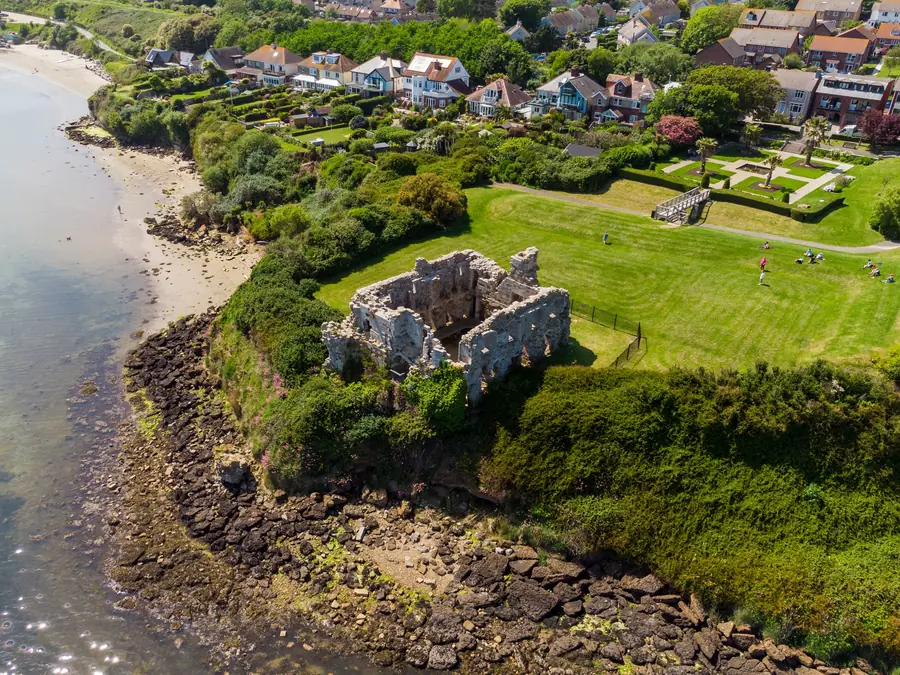
Sandsfoot Castle stands on a low cliff at Old Castle Road, about two kilometres south of Weymouth town centre, looking across Portland Harbour to the Isle of Portland. It is a Henrician artillery fort, not a medieval keep, and what you visit is a consolidated ruin in a small public garden. The interior is fenced. The view does most of the work.
It is free. That is the first practical fact, and the reason to put it on a walk rather than in a car-park itinerary of paid forts.
Henry VIII broke with Rome and then expected France and the Holy Roman Empire to do something about it. The Device programme of the late 1530s and 1540s was the response: a chain of coastal gun forts built to fire at ships, not to survive a baronial siege. Sandsfoot — historically also called Weymouth Castle — was the Weymouth-shore half of a pair. Portland Castle, on the island opposite, was the other.
The stone castle had an octagonal gun platform linked to a residential blockhouse, and it was completed by 1542 at a cost of £3,887. Shortly after construction it worked with Portland to cross fire over the Weymouth Bay anchorage between them. Earthwork defences were added on the landward side, probably in 1623.
It saw service in the Civil War, held by Parliament and by Royalists in turn. It survived the interregnum. After Charles II’s restoration it was withdrawn from military use in 1665. Everything since has been weather, stone-robbing and, latterly, a garden.
The job was the anchorage, not the town. Before the great breakwaters of the nineteenth century, Portland Roads was the sheltered water that a fleet could use, and two forts on opposite shores could deny it to anyone coming up the Channel. Sandsfoot sat on the mainland cliff; Portland sat on the limestone. The water between them was the point.
That geography is still the visit. You stand in the garden, look south, and the island is a wall. The breakwaters that now enclose Portland Harbour — convict-built, from the 1840s — were not there when the guns were mounted. The castle was taking the sea on an open shore. That is why so little of it is left.
Do not confuse it with Nothe Fort. The Nothe is Victorian, Palmerston, 1860–72, built to defend the new naval harbour, and it is a ticketed maze of casemates. Sandsfoot is a century earlier, smaller, free, and already a ruin when the Nothe was being dug.
Erosion. Sandsfoot was built on soft cliff. The sea has been undermining it since the seventeenth century. The gun platform collapsed onto the beach. The blockhouse was quarried for stone. By the nineteenth century what remained was a picturesque shell, unsafe, and by 1930 it was closed.
Portland Castle, built of the island’s own limestone on a sheltered shore, is one of the best-preserved Device forts in the chain: fan-shaped, complete, English Heritage, an audio guide in the rooms. The two forts are a lesson in geology as much as in fortification. Standing at Sandsfoot and looking at Portland is the whole argument in one view.
The remains were consolidated and stabilised a little over a decade ago, with Heritage Lottery money and the Friends of the Rodwell Trail and Sandsfoot Castle. That work halted the loss. It did not put the gun platform back. Be clear before you go: the ruins are fenced and cannot be entered. You look at them from the garden. Several visitors note the fence with regret. They are right about the fence and wrong if they expected a keep.
Sandsfoot Gardens are the actual destination. A small, well-kept public garden immediately above the castle: lawns, seasonal beds, herb planting, an ornamental pond, benches aimed at the water. A kiosk or café at the entrance does teas when it is open — hours follow the season, not a paragraph in a guide. Toilets on site.
The gardens were laid out in the mid-twentieth century in a loosely Tudor manner, which is a conceit, and they work because they are small and looked after. The Friends volunteer on them. Green Flag status has been awarded in past years for the usual reasons: safe, clean, welcoming. Children need watching near the cliff edge and should not be left unsupervised among the ruins, fenced or not.
Time: twenty to thirty minutes, longer if you sit. That is the honest visit. People who came expecting Portland Castle’s rooms are disappointed. People who came off the Rodwell Trail for a view and a bench are not.
This is the other half of the ticket, and there is no ticket.
From the garden you look across Portland Harbour and its breakwaters to the island, and east along the Dorset coast. On a clear day the geometry is sharp: the limestone plateau, the worked quarries, the harbour that held a navy and then the 2012 sailing. Chesil begins at the island’s root; this page does not repeat that landscape. The Portland and Chesil article is the document for the shingle, the Bill and Tout Quarry.
Late afternoon is the light on the island. A south-westerly is the wind. There is almost no shelter once you are on the seaward side of the beds. Dress for it.
The aerial photograph most people have already seen is this cliff, this ruin, this harbour. Being there is quieter than the picture. The sailing club sits at the bottom of Old Castle Road. Castle Cove is the water under the cliff, not a second beach day.
Sandsfoot is on the Rodwell Trail, the level walking and cycling path on the old Weymouth-to-Portland railway, running about three kilometres from the town to Ferrybridge. Cuttings, a tunnel, no traffic. It is the easiest walk in Weymouth, and the castle is the reason to step off it.
From the town centre it is about twenty-five minutes on foot. From Weymouth Harbour you are already on the right side of the water; follow the south quay and the trail south rather than recrossing the Town Bridge. The walks guide picks up both ends.
By car, Old Castle Road is a dead-end with a handful of bays near the sailing club. They are not a plan on a sunny Saturday. Swannery and the trail, or the bus toward Portland as far as Wyke, are the grown-up versions. Details in the parking article.
The gardens are largely level. The castle ruins are not a wheelchair visit, because they are not a visit you enter. The cliff is the constraint, not a flight of tower stairs.
The two forts were designed as a pair. Visiting both in a day is the historical sequence, and it is not a walk.
Portland Castle is at Castletown, fifteen minutes by road, on the island, English Heritage, ninety minutes to two hours once you are inside. The year-round 1 bus from King’s Statue crosses the causeway to Fortuneswell and Easton; the seasonal open-top 11 goes on to the Bill. Neither drops you at Sandsfoot. Do Sandsfoot on the way out or the way back, on the trail, and give Portland its own hours.
Do not skip Portland because you have seen Sandsfoot, and do not skip Sandsfoot because Portland is “the real castle”. One is a complete gun fort you pay for. The other is a free ruin that explains why the complete one survived. The Portland Castle attraction page is the interior; this page stops at the fence.
Nothe Fort is the third fort in the same small geography, a different century, on the peninsula between Weymouth Harbour and Portland Harbour. A harbour morning, a Nothe afternoon, Sandsfoot on the trail the next day is a better sequence than three forts before lunch.
It is not English Heritage. Portland is. Membership does not open a gate here, because there is no gate that takes a ticket.
It is not a beach. Castle Cove below is pebbly, local, and not the gently shelving sand of the town. Swim in Weymouth Bay.
It is not a wet-weather destination. The gardens are open to the sky. In rain, the Nothe’s tunnels and the harbour pubs are the plan; see Weymouth in the rain.
It is not a half-day. If you have a half-day, go to Portland Castle or the Nothe. If you have twenty minutes on the walk south, stop here. The free list puts it with the gardens and the trail, which is the right company.
The castle is a scheduled ruin on an eroding cliff that the council and the Friends have chosen to keep looking at. That is a modest, decent thing. Come for the garden, the view to Portland, and the fact that Henry’s other fort is still standing on the far shore. Then walk on.